
Evolutionary features of trees
Evolutionary features
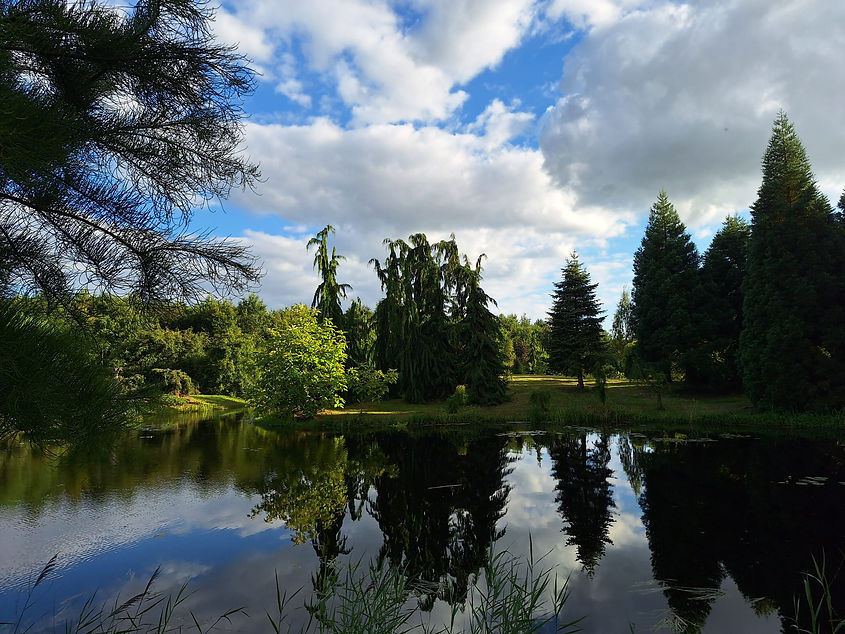
At Arboretum Tenaxx, you see evolution in action: variation within species and selection by climate and soil; co-evolution between trees and animals; and the role of energy/thermodynamics in growth and decay. Weeping forms and native species side by side make differences immediately visible.


Living fossils or paleorelicts
Living fossils are a special group. These are trees that outwardly bear a strong resemblance to the oldest fossils from the Mesozoic era, the time when dinosaurs lived. They were once widespread but survived in refugia: sheltered places where they could withstand ice ages and other climate changes. Their distribution area is often limited today. As a result, they are vulnerable to extinction in the natural environment.
The term 'living fossil' can be misleading because the species has indeed evolved, its DNA continues to change, and modern populations are adapted to current climates. That is why scientists prefer to speak of paleorelicts.
They show how resilient and vulnerable nature has been over millions of years, and connect us to deep time. They demonstrate ancient survival strategies.
Examples of paleorelics in our collection are the
Ginkgo Biloba · Metasequoia Glyptostroboides · Araucaria Araucuna · Taxodium Disticum and Ascendens · Sequoiadendron Giganteum · Sequoia Sempervirens, Taiwania cryptomeroides, Magnolia, Sciadopitys verticillata and Davidia involucrata.


Ginkgo biloba (Japanese nut tree)
The Ginkgo biloba is the oldest living fossil! It has existed for over 200 million years! It even predates the first dinosaurs. Once widespread throughout the Northern Hemisphere, the ginkgo now only grows wild in western China. The ginkgo is China's national tree and is sacred to Buddhists. It is neither a conifer nor a deciduous tree; it is the only one of its kind. The ginkgo has unique, fan-shaped leaves that turn a beautiful golden yellow in autumn. It is hardy and pollution-resistant, making it a popular choice for urban plantings. Ginkgos can live for over 1,000 years, with some in China even over 3,000 years old! The ginkgo not only survived the meteorite impact that wiped out all land-dwelling dinosaurs, but also literally an atomic bomb: a specimen found just 1 km from the Hiroshima explosion is still alive!
Metasequoia glyptostroboides
(Chinese watercypress)
The Metasequoia glyptostroboides, also known as the Chinese water cypress, is a true primeval tree! This living fossil grew as far back as the Jurassic and Cretaceous periods, when dinosaurs still roamed the earth. Although long considered extinct, it was rediscovered in 1941 in a remote valley in China—a true botanical sensation! Unlike other Sequoias, the Metasequoia loses its needles in winter, just like the larch and the taxodium. In autumn, its needles turn a beautiful orange-red. It grows incredibly quickly, sometimes as much as a meter per year! After its rediscovery, the tree was spread worldwide by botanists and now graces many parks and gardens. In this way, humans contribute to its survival! Its deeply grooved trunk is quite unusual. The Chinese Metasequoia is not related to the Californian sequoia.


Araucaria araucana
(Monkey puzzle)


The Araucaria araucana is a true survivor! This tree was already growing in the time of the dinosaurs. Its twisting branches and scale-like leaves later earned it the nickname "monkey puzzle" since Sir William Molesworth, the owner of a young specimen, was showing it to a group of friends when one of them, Charles Austin, remarked "It would puzzle a monkey to climb that".
The Araucaria is a living fossil because it has existed for about 200 million years and has hardly changed in appearance.
Its spiky leaves are arranged according to the Fibonacci sequence, allowing them to capture maximum sunlight. Its branches are covered in sharp, triangular needles, a natural defense against herbivores! It can live for over 1,000 years and defies extreme cold and heat. In the age of the dinosaurs, the araucaria was widespread worldwide. Now, the tree is native only to Chile and Argentina, where it is sacred to the Mapuche people.
Taxodium (Swamp cypress)
Taxodium is an ancient genus that has been growing on Earth since the Cretaceous period (more than 100 million years ago). It is adapted to swampy areas and has a special trick for survival: its “breathing roots”, or pneumatophores, which protrude from the ground like nodules to absorb oxygen. The hanging gardens have several species: Taxodium distichum, Taxodium ascendens and Taxodium nutans.
The swamp cypress can live for thousands of years, with the oldest known specimens being over 2,600 years old! It grows in swamps and river deltas and can even survive floods. In autumn, it turns a beautiful reddish-brown colour, after which it loses its needles, just like the metasequoia and the larch. The famous “ghostly” trees in the swamps of Louisiana and Florida are often swamp cypresses. The wood is extremely durable and rot-resistant, allowing old trunks to be preserved for centuries. The Tenaxx estate has a beautiful collection of weeping forms of Taxodium.


Sequoiadendron giganteum
(Giant Sequoia)


The Sequoiadendron giganteum is the largest tree in the world and a true survivor. The sequoia was native to the entire Northern Hemisphere during the Cretaceous Period, the time when the T. rex lived. It is now found only in California. The giant sequoia is a giant: the tallest specimens grow to over 90 meters tall and have a trunk circumference of over 30 meters! It can live for over 3,000 years and continues to grow even after thousands of years.
Its bark can be up to 75 cm thick, protecting it from insects, disease, and fire. It survives forest fires better than its competitors! This is not only due to its thick bark, but also because most seeds are only released when the cones dry out from the heat of the fire. In California stands the famous "General Sherman Tree," the largest tree in the world by volume! The Tenaxx Estate boasts an impressive driveway lined with giant sequoias and a giant sequoia grove with a beautiful view of the pond.
Sequoia sempervirens (Costal Redwood)
The ancestors of Sequoia sempervirens already grew during the time of the dinosaurs in the Cretaceous period (more than 100 million years ago).
The Coastal Redwood is the tallest tree in the world. The tallest known tree, Hyperion, is no less than 115.92 meters high! It can live for more than 2,200 years and continues to grow throughout its life. Its wood contains a lot of tannins, which makes it almost immune to insects, fungi, and rot. Thanks to its thick bark, it is extremely fire-resistant. Forest fires even help spread its seeds!
In the dinosaur era, its ancestors grew throughout the northern hemisphere, but now they are limited to a narrow strip along the coast of California. This makes them living fossils.


Cunninghamia lanceolata
(Chinese fir)


Cunninghamia belongs to a very old evolutionary branch of the cypress family. Relatives already appear in fossils from the Late Cretaceous (66–100 million years ago). Ancestors of Cunninghamia likely grew in large parts of East Asia, Siberia, North America, and possibly in Europe. Due to climate change, ice ages, and competition with flowering plants, the distribution area shrank significantly. Today, natural populations are found mainly in the humid subtropical mountain forests of South and Central China (Cunninghamia lanceolata), and in parts of Vietnam and Laos (Cunninghamia konishii). Consequently, Cunninghamia is considered a typical relic genus: a remnant of a once much larger group.
The tree is recognizable by its stiff, pointed needles arranged spirally around the twigs and by its primitive-looking cones. The thick bark provides protection against fire and fungi. The wood is tough, durable, light, and fragrant due to resinous substances. It has been used in China for centuries for temples, furniture, bridges, and shipbuilding. Thanks to its rapid growth, large plantations have been established.
In remote Chinese mountain regions, there are specimens that are more than a thousand years old.
Cathaya argyrophylla
(Cathaya pine)
The oldest fossils of Cathaya date back to the Cretaceous period. These are fossilised pollen grains that are 110 million years old. At that time, Cathaya was common in the northern hemisphere. During the ice ages, the species died out in North America and Europe.
Nowadays, Cathaya only occurs in small populations in the subtropical mountainous regions of southern China. The species shows only slight genetic diversity. Its survival is also threatened in China because there are so few young trees. In total, there are fewer than 4,000 specimens in China. This makes Cathaya a living fossil.


Taiwania cryptomeroides

Taiwania cryptomeroides is a living fossil. It is the only surviving species of the genus Taiwanioideae, a subfamily of the Cupressaceae, from which it diverged in the Jurassic period.
The oldest fossil is 106 million years old and was found in Alaska. The current Taiwania still closely resembles it in shape. Other fossils originate from Asia, North America, and Europe. Exchange probably took place via the Bering corridor, which connected Asia with Europe.
Taiwania lived in geological times under varying climatic and ecological conditions, including the cold and unique light conditions of the polar regions.
Today, the species is only found in the mountains of northern Taiwan and locally in southwest Asia. The wood has an attractive spicy scent. The species is rare, grows slowly, and is protected in China and Taiwan.
Davidia involucrata
(Handkerchief tree or Ghost tree)
Fossil finds indicate that Davidia was widespread on the northern continents during the late Cretaceous and Tertiary periods and migrated between North America and Asia via the Bering Bridge. This allowed Davidia to establish itself in both North America and East Asia. During the ice ages, its range declined sharply.
Today, Davidia is threatened with extinction in the wild. The plant is now only found in the mountainous regions of south-western and central China, which is why it is considered a living fossil.
Davidia is often planted in botanical gardens around the world because of its striking white bracts, which hang down like “flags” and protect the pollen from rain in May, attracting pollen-eating bees and beetles.


Magnolia


Magnolia is considered a living fossil because its flower structure and the family (Magnoliaceae) are extremely old.
Magnolia is one of the oldest and most primitive flowering plants in the world. It has only undifferentiated petals, no separate sepals and petals, and these are arranged in a spiral. This contrasts with the whorl arrangement found in most flowering plants.
The flowers resemble the oldest known fossil flowers from 100 million years ago (Late Cretaceous). Magnolia was alive before bees; it is pollinated by beetles. These beetles crawl into the flower to collect nectar, carrying pollen grains along with them. In this way, they ensure the reproduction of Magnolia.
They were a tempting meal for herbivorous dinosaurs.
Magnolia is now native to North and Central America, the Far East, China, and Japan. Fossils of magnolias have been found in Europe, but they became extinct here during the Ice Ages. Later, magnolias were widely planted in gardens and parks here for their beautiful flowers. The Hanging Gardens feature various magnolia species from Japan, China, and North America.
Sciadopitys verticillata (Japanese umbrella-pine)
The Sciadopitys verticillata is an ancient species, the only surviving member of the Sciadopityaceae family and the Sciadopitys genus. It is a true “living fossil”. The oldest fossil finds date back to the Upper Triassic period, approximately 230 million years ago. At that time, the genus was widespread in North America, Europe and Asia, which were then still connected as Laurasia, the northern part of Pangaea. The Sciadopityaceae were already disappearing in the Cretaceous period, even before other ancient conifer groups such as the Araucariaceae became widespread.
Today, the species only occurs naturally in Japan.
The species is characterised by its striking “needles”. These are not needles, but whorled, shiny, dark green modified stem structures (phylloclades) that resemble needles. They are arranged in umbrella-shaped clusters at the ends of the branches. This is where the tree gets its name.
